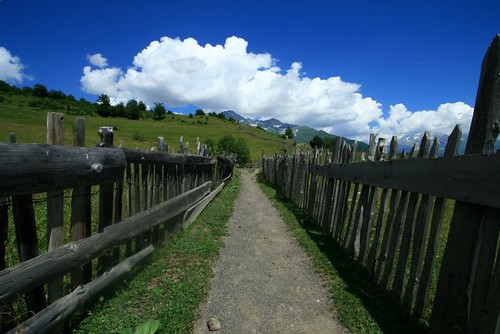
Below are journal entries written over the last five days, describing my experience in Georgia. I am currently in Mestia, a small town in the northern region of Upper Svaneti, waiting for a chance to travel south to Turkey.
When I arrived in Kutaisi, and found my way to the home of Mediko and Suliko - an elderly Georgian couple who open their home to travelers - there was no news yet of any fighting in South Ossetia. Mediko covered the table with a huge spread of traditional Georgian dishes, and Suliko proceeded to propose toast after toast, insisting that I join him in downing a glass of wine with each one. There was a brief mention of some trouble in Tshinkvali but Suliko dismissed it as a routine occurrence. I thought nothing of it and stumbled off to bed.
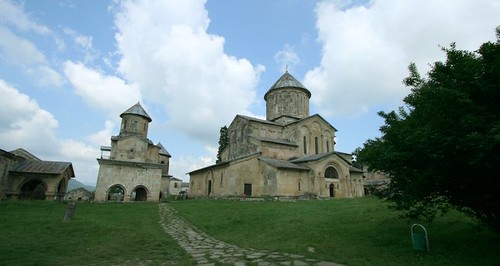
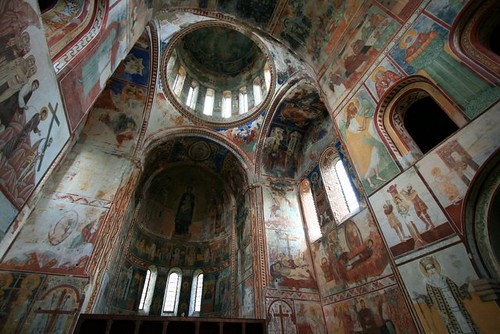
The next day I did some sight-seeing around Kutaisi. The nearby famous Gelati church was my first stop. On the way I made friends with some young Georgian guys. They were in the country for a visit, actually - they live in Moscow as refugees. During the fighting in the early 1990s, they were forced from their homes in Abkhazia. Just as we were leaving Gelati together, news of the Georgian army having taken Tshinkvali was being broadcast on the radio and they were optimistic about the situation, assuring me that Russia would let it be. Later, when I checked my email in town, I learned that the situation was quickly changing. Russian bombs were falling over Tshinkvali, casualties were adding up, and harsh words were flying between both governments. Still, Kutaisi felt a world away from all of this, and I was reassured by everyone that the rest of Georgia would remain peaceful.
The dinner table at Mediko and Suliko’s house that evening was dominated by the television. Suliko moved it from the bedroom so that we could stay updated on the situation which appeared to be worsening by the hour. There wasn’t much concrete information to be had but we learned that the Georgian army was under heavy attack from the Russians. Despite this dire news, Suliko and Mediko both urged me to continue traveling north to Svaneti.
“This will be over very soon. Mestia is always safe,” Mediko told me.
So, acting against my gut feeling that the fighting was sure to escalate, I caught a mashrutka to Zugdidi and then another to Mestia the next day.
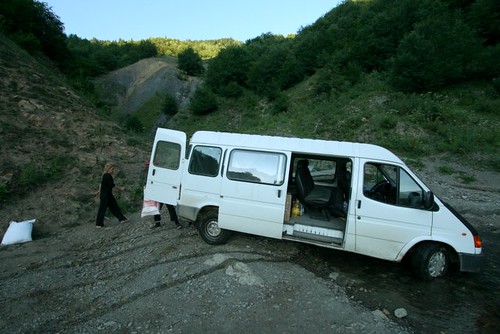
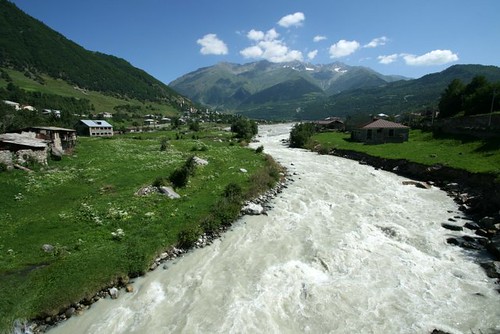
It wasn’t until my arrival in Mestia that the situation reached its worst point. Russia was striking strategic targets throughout the country - Poti, Gori, Tbilisi, Zugdidi, Kutaisi - and most of the international community was issuing limp-wristed threats of “deteriorated relations between Russia and the West” in supposed outrage.
This morning, seemingly in response to the impending arrival of an EU envoy, including French chairman Sarkozy, Medvedez announced an end to the current campaign in Georgia. At the moment, it looks as if the violence in and around the region of South Ossetia has ceased. Russian forces have re-established their control and the Georgian military has been pushed back to Tbilisi. However, a new front appears to have opened up on the border of Abkhazia, a second self-proclaimed independent state which lies to the northwest of Georgia.
The Kodori gorge, the easternmost part of Abkhazia, has been the last piece of the state still controlled by Georgian forces. Taking advantage of current events and with Russia’s support, the Abkhazian army cut off a pocket of Georgian soldiers and civilians from roads connecting them with Georgia and then offered an ultimatum: disarm and retreat or we will “persuade you to do so by any means necessary.”
The Kodori gorge lies less than 50km to the west of Mestia, where I am now. Apparently the Georgian soldiers complied with the the demands of the Abkhaz army and made their way out of the region by taking the old, disused mountain road through Ushguli. Today a small panic rippled through town when Georgian helicopters flew overhead, presumably to help moving refugees to Ushguli. Just this evening, about 50 Georgian soldiers arrived in Mestia.
My personal opinion regarding the situation is that despite his current role as the victim of a supposedly unprecedented response from Russia, Georgian president Saakashvili is mostly to blame for the loss of life on either side of the conflict of the last several days. Knowing full well that Russia has effectively maintained control of South Ossetia for the last decade, he sent his under armed, largely untrained army - a fraction of the size of Russia’s - into a fight that was doomed from the start. It’s possible that he was counting on aid from allies in Europe and the USA, but that was a grave misjudgment on his part. Once within Tshinkvali, the Georgian army was harsly beaten back - according to local news, one unit of 600 men lost all but 60. And this is little in comparison to the number of dead among the Ossetians, which may be in the thousands. In the end, it looks as if Georgia accomplished nothing more than finally losing all control of both South Ossetia and Abkhazia to their Russian-backed enemies and suffering huge losses in the process.
That said, Russia’s underhanded tactics in exercising it’s influence are the ultimate cause of this mess. Ever since the inception of Georgia as an independent country, Russia has been providing support to separatist groups in Abkhazia and South Ossetia as a means of weakening Georgia’s integrity. This recent outbreak of violence is only one of many such episodes in the past. Russia’s reasoning for entering the conflict was that it must “defend its citizens” - a situation it cleverly engineered by offering Russian passports to the people of South Ossetia over the past few years. According to Russian sources, as many as 90% of the South Ossetians have accepted these passports. The Georgian media reports this figure to be closer to 50%, but in any case the Russian government has cleverly created a situation in which they can justify all-out war over territory that has not been considered theirs by anyone since 1993.
The nationalist noise coming from Saakashvili, and the sentiment among locals that he has commited an unforgivable wrong against the Georgian people and must step down from his post, all amount to a troubling situation for the country. The U.S. Department of State today issued a warden report advising all American citizens to leave Georgia as soon as possible. They also evacuated all Peace Corps volunteers to Armenia, and are operating a daily convoy from Tbilisi to Yerevan. The problem for me is that I am stuck in western Georgia - if I could get to Tbilisi safely, I’d have little to worry about but all roads from Mestia pass through the troublesome town of Zugdidi.
This evening, a contingent of Russian soldiers arrived and have put themselves up in the administration center just around the corner, right here in Mestia. There is a nervous buzz around town, with little for anyone to do but sit around, eat, and worry. Until I can find someone willing to drive me out of Svaneti, I will remain here…
About 30 minutes ago, my friend Levan at the CTC in Mestia received word that a larger group of Russian soldiers is headed to Mestia, and will arrive in the evening. I will be following the news closely. Another tense day in beautiful Svaneti…