Skip to Content Skip to Search Go to Top Navigation Go to Side Menu


Archive for April, 2008


Northern Kenya Pt. II


Thursday, April 3, 2008

I was just going to append this to the previous entry, but since “tomorrow” was a long time ago, here is the rest of the story:

***

I had just enough time to eat a shitty breakfast at Jey-Jey’s restaurant before we pulled out of Marsabit. Soon I was speeding over the rock-strewn road in a cushy 4×4 with ten other locals.

If the landscape between Isiolo and Marsabit is desolate, here it takes on an other-worldly isolation. The five-year drought has done away with all but a few tufts of the most hearty desert scrub and the nomadic Borana people have almost all moved north into Ethiopia in search of greener pastures. Even some of the famous old “singing wells” are no longer yielding water. What remains of the great plains of northern Kenya is a series of oppressively hot dust bowls punctuated by a few small volcanic peaks. The road, which has never been paved and barely exists in some spots, cuts a nearly straight line through the fields of black volcanic boulders.

Every once in a while we would pass through a tiny village. None of them could have been home to more than a few dozen families, all living in a state of poverty that puts them just a notch above mere survival. Aside from a shop or two with nearly empty shelves, a cluster of round thatch huts roofed with plastic rubbish and maybe a restaurant catering to the few passers-by, there is nothing. The only signs of life outside these outposts are the occasional herds of goats.

For the first three hours of the drive I thought the other passengers were just really friendly - the driver stopped the car for them to chat with every person they saw - but he eventually explained to me that this was a shopping trip for them. In two days there was to be an important ceremony, for which they needed to purchase and slaughter a goat. Unfortunately they didn’t find a suitable one at the right price so I didn’t have the pleasure of spending the rest of the journey in the cramped back seat with an angry goat. Too bad.

We rolled into the Kenyan half of Moyale at around 2pm. I was instantly reminded of the Cambodian town of Poipet at the Thailand / Cambodia border, but even that doesn’t describe the absolute “edge-of-the-world” feeling of Moyale. Generally speaking, border towns tend to be filth and sleaze magnets, and Moyale is no exception. I walked a couple of km’s through town toward the border, trying not to attract any more shady touts, crooked money-changers, prostitutes, begging children or random dodgy characters than was naturally unavoidable.

I have walked across several borders, in Africa and elsewhere. Its a pretty routine procedure, provided you’ve sorted out the paperwork, and is usually quick and painless. The one part, though, that will always make me anxious is changing money with the black market traders.

The situation is always heavily weighted against you: you’re often tired, sweaty and dirty after a long bus / truck ride, you’re naturally ill-informed about up-to-date exchange rates, and you have to concentrate on working out the mathematics of a fair exchange while the pushy, shifty-eyed changers do their best to confuse you. Then factor in the pack of sticky-fingered children hovering around your bags and even the most level-headed traveler can hardly help acting like a paranoid schizophrenic.

Ethiopia presents an added complication: since there are no ATMs in the country which accept Mastercard-branded plastic, I was forced to carry a large wad of cash into the country. I’m happy to report that I did well at the Moyale border - I managed to get slightly better than the official rate while changing $300 worth of Kenyan Shillings into Ethiopian Birr - although it was a stressful experience.

On the other side, the Ethiopian immigration official was a bit confused by my passport and initially told me I couldn’t enter the country.

“I scanned it into computer, says ‘nationality not found.’ Maybe you need new passport?” He indicated the worn out cover and frankenstein hack-job the US embassy in Cairo did with the new set of extension pages.
“Maybe you can try again?” I suggested.

He kept trying, but eventually had to make some phone calls to work things out. I finally got my stamp and went on my merry way…

The Ethiopian side of the road is a golden paradise compared with Kenya’s half. Well, not exactly but I felt immediately at ease walking the much calmer streets. I found a cheap hotel and had my first Ethiopian meal: injera, doro wat and a kiddus giorgis beer. After weeks of fried chicken, eggs and chips in Kenya and Tanzania, the food in Ethiopia is indescribably good. Slow-roasted meat, spicy sauces, fresh fruit and vegetables… variety! I slept like a baby and left at 5:00am the next morning for Awasa.

Awasa


Sunday, April 6, 2008

I could tell right away that I was going to love Ethiopia: my bus left right on time, with just one person in each seat. There weren’t mysterious, foul-smelling sacks stuffed into every crevice. The driver obeyed the speed limit and the road was smooth. At every stop, other passengers wanted to make sure I was enjoying the ride - did I need any water? A snack? It was one the best bus rides I’ve had in Africa.

We picked up a few passengers in Mega about an hour into the journey. An Ethiopian guy about my age took the seat next to me. I noticed that he was reading Dark Star Safari by Paul Theroux, a book I’ve seen a couple times in the hands of travelers on my up from South Africa. Its about the author’s trip from Cairo to Cape Town - my route in reverse. Since he obviously spoke English, I started up a conversation and we talked for hours - about politics, religion, travel. Tewodoros (Tedy) told me lots of interesting things about Ethiopia.

“Ethiopia has 80 different tribes. They’re everywhere. Just behind this hill here, there is a community where it is written law that the men must not ever work. They sit all day chewing chat while their wives do all of the farming. It’s crazy, but that it what they do.”

I borrowed his book long enough to read the chapters about the same leg of travel that I had just done over the past few days (Nairobi to Moyale). It was nice to see that Theroux was as impressed as I was with the madness in northern Kenya, although he didn’t have my luck with avoiding the shifta! It doesn’t seem as if much has changed since his trip 5 years ago. I also quickly read through the chapter about his days in Sudan. If I can secure a visa, I have a lot to look forward to…

Tedy used to run a record shop in Addis, so I asked him for some music recomendations. I’ve heard some great/interesting/downright weird music here so far. Most of it sounds like a blend of Indian/Arabic/African styles - rhythmic, energetic music with overblown Arabic-sounding vocals.

When we arrived in Awasa, Tedy offered to show me around for the day and then take me to stay with his family in Addis! I was amazed - he hadn’t even been planning to go all the way to Addis, yet he gave up his entire weekend to show a random foreigner around.

We ended up having a good night out in Awasa. We hit every club in town (all 5 of them) and drank and danced ’till the wee hours.

Addis Ababa


Monday, April 14, 2008

The short bus ride from Awasa to Addis included a stop in Shashemene, a place with an interesting history as the ‘homeland’ of the Rastafarians. Wikipedia provides a brief description of Rastafarianism:

The Rastafari movement (also known as Rastafari, or simply Rasta) is a new religious movement that accepts Haile Selassie I, the former Emperor of Ethiopia, as God incarnate, called Jah or Jah Rastafari. He is also seen as part of the Holy Trinity as the messiah promised in the Bible to return. The name Rastafari comes from Ras (literally “Head,” an Ethiopian title equivalent to Duke), and Tafari Makonnen, the pre-coronation name of Haile Selassie I

And then later on explains the connection with Shashemene:

Haile Selassie I had already met with several Rasta elders in Addis Ababa in 1961, giving them gold medals, and had allowed West Indians of African descent to settle on his personal land in Shashamane in the 1950s. The first actual Rastafarian settler, Papa Noel Dyer, arrived in September 1965, having hitch-hiked all the way from England.

Haile Selassie visited Jamaica on April 21, 1966. Somewhere between one and two hundred thousand Rastafari from all over Jamaica descended on Kingston airport having heard that the man whom they considered to be God was coming to visit them. They waited at the airport smoking a great amount of cannabis and playing drums. When Haile Selassie arrived at the airport he delayed disembarking from the aeroplane for an hour until Mortimer Planno, a well-known Rasta, personally welcomed him. From then on, the visit was a success. Rita Marley, Bob Marley’s wife, converted to the Rastafari faith after seeing Haile Selassie; she has stated that she saw stigmata appear on his person, and was instantly convinced of his divinity.

Read the rest of the Wikipedia article here.

Several dozen Rasta families still call Shashemene their home. As Tedy explained, most Ethiopians these days think the Rastas are a bit silly to consider their former king a divine figure and frown upon the cultivation and use of cannabis. Since we stopped in Shashemene for only an hour or so, I didn’t get the chance to meet any locals.

***

When we arrived in Addis, Tedy took me to his parents’ home in the outer eastern district of Altad. Although he referred to the area as a village, it was completely urban. He led me through several dark unpaved alleys on the way to his place. I’ll admit that I was feeling a little nervous about being led into an area where foreigners rarely tread by a stranger whom I had just met the day before, but everything turned out fine.

Tedy’s place was three small, externally identical, free-standing concrete rooms in a little yard sealed off by a corrugated steel wall. I greeted his mother, his father, his sister and her husband, and played with his little niece. They set out some pillows and a blanket for me on a sofa, which was pushed into the corner of one of the rooms underneath a large shrine to the virgin mary, complete with electric candles. I dropped off my bags, then we set out for dinner and a night on the town.

Tedy took me to a part of town nicknamed “Chechniya” (he couldn’t explain why nor could i figure it out). Its a safe but slightly seedy district and thus perfect for cheap drinks a late night out. We hit a few bars and then went to a restaurant hosting an Ethiopian singer and some traditional dancers. We split a bottle of tej - a traditional Ethiopian drink made from fermented honey, like mead.

One of my favorite things about going out in Ethiopia is that Ethiopians have no fear of being first on the dance floor. If their song comes on, they’ll just get up and start shaking it. I often saw people at restaurants just stand up at their table, dance for a minute, and then sit down. And the way they dance! Like nothing I’ve ever seen before. Here’s someone else’s video of a Tigrinya “headshaker”.

We drank and danced until late.

***

I’m not feeling very inspired to write at the moment, but I’ve got a 70-page notebook full of notes from my 5 weeks in Ethiopia and I would like to put it aside so I can start writing about Sudan. I have so much to write about but its just piling up and I’m not going to be able to take the time and type out entries for everything.

So, instead of some stories, here is a list of some things I loved about traveling in Ethiopia:

  • Coffee - Ethiopia is the birthplace of coffee. According to legend, a farmer discovered it thousands of years ago while tending to his sheep. He noticed that they became very active when they ate the berries of a certain bush. He brought them to a local monastery where they eventually figured out that you could brew them into a drink… Modern Italian espresso machines are found in even the smallest, least developed towns around the country. A cup never costs more than 2 or 3 Birr ($0.30 at the most). Served strong and sweet!
  • Fresh Juice - Also found nearly everywhere throughout the country are little bars serving fresh juice. The best thing for breakfast or after a day walking around in the heat.
  • Food - I love Ethiopian food.
  • Language - The official language of Ethiopia, Amharic, is unique in many respects. It is a semetic language, but uses its own syllabary (alphabet). When I first arrived in Gonder I bought a children’s schoolbook and over the next few weeks managed to teach myself to read and write using the Amharic and Tigrinya syllabaries. They have some notable connections to Hebrew and Arabic and even share a couple of the same letters.

My apologies for the most boring post in a while.

In the meantime, I am in Khartoum, Sudan. I finally got my visa from the Sudan Embassy in Addis! I’ll be here for 10 more days before I cross into Egypt and make my way to Cairo for the great reunion with Gartholomew J!

The Nile Route, Days 1 and 2


Sunday, April 20, 2008

I’m sitting in a minibus in my least favorite place in Ethiopia: the Bahir Dar bus station. It’s 11am. I’m waiting for the bus to fill up with other passengers going north to Gonder. Three weeks ago, when I had given up on trying to get a visa for Sudan, I left Addis Ababa for a trip around northern Ethiopia that took me to Bahir Dar, Gonder, Shire, Aksum, Wukro, Mekele, Woldia and Lalibela. I’ve traveled on this road before; its a pleasant trip - just a couple hours with nice views - but the scene at the bus station is ruining it for me. I know that the correct price of this ride is 35 Birr, yet I keep being told the most creative, elaborate lies in attempts to get me to pay 50 or 60 Birr. The only way to get the touts to leave me alone is to shout at them. It gets old fast. For some reason, the Bahir Dar station is the worst for this.

***

Finally, we’ve left. The weyero came around and I quietly paid my 35 Birr along with everyone else.

Bahir Dar was my first stop on the long journey north into Sudan from Ethiopia. After weeks of runaround and diminishing hope, the Sudanese consulate in Addis finally granted me a two-week transit visa. Because my plan in to move overland across the country and enter Egypt via the weekly Lake Nasser ferry at Wadi Halfa, I must time my entry into Sudan carefully in order to have enough time to comfortably get to Wadi Halfa in time for the ferry. It should take 5 days to reach Khartoum from Addis by bus.

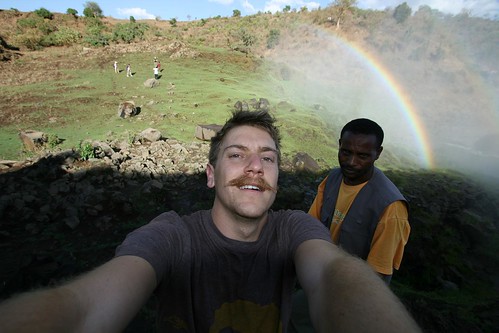
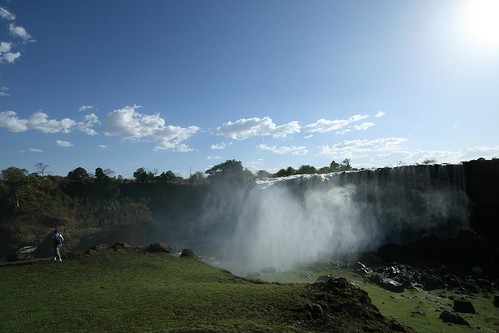
I stopped for a day in Bahir Dar to make a symbolic visit to the source of the Blue Nile. Lake Tana is the source of one half of the great Nile, which I will follow, more or less directly from there all the way to Cairo, just before it flows into the Mediterranean Sea. I went out to the village of Tis Abay in order to see the famed Blue Nile falls (Tis Isat). A few years ago, the falls were reduced to just a depressing trickle compared to their former glory with the construction of a large hydro-electric dam. Lucky for me, though, the turbines were undergoing repairs and the water had been temporarily diverted back to the falls. The falls were impressive, the perpetual wall of mist creating several vivid rainbows in the afternoon sun. I was able to walk directly up to the rocks on which the falls broke and get completely soaked in the spray. It was a spectacular way to start the 3-week adventure which will finish thousands of miles later at the other end of the Nile.

The Nile Route, Day 3


Sunday, April 20, 2008

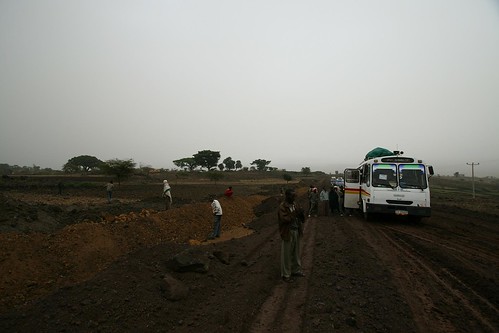
I arrived in Shihedi after a rough ride from Gonder that began at 4am. The last few days have brought the first rains of the season - normally dusty dirt roads have turned into muddy tracks. My backpack got thoroughly soaked on top of the bus thanks to a poor covering job by the weyero. It was slow going.

In just one afternoon I was able to see all that Shihedi had to offer. I passed the day chewing chat, drinking coffee, and chatting with locals. Most of that time was spent sitting in a dingy “chat den” conversing in broken English with a few strange characters.

The “den” was a small typical Ethiopian construction, with a dirt floor and mud-plastered walls. Balanced atop a pile of bricks in the corner sat a TV and DVD player, blasting out a continuous stream of Ethiopian pop music videos. The owner sat by the doorway, weighing out bags of chat on an old balance scale. A cooler stocked with Coca-cola and water sat opposite him across the room. A bench along each wall filled the remaining space. The walls were bare but for 3 large posters: Britney Spears (circa 2003, captioned “In the Zone”), Ronaldinho (”OK”), and Jennifer Lopez (striking a sexy pose, showing off her wedding ring).

I chewed nearly 100 grams of fer-fer (loose leaves) over a few hours - I was a bit high. The conversations, all translated by the one guy present who spoke some English, revealed a lot about the sad story of Shihedi.

Just an hour into Ethiopia from the border with Sudan, Shihedi is a small truck-stop town for drivers who ply the route between the two countries. Most of it is made up of cheap hotels, bars and brothels. It has a reputation for being quite a rowdy place - the horrible state of the economy has made catering to these truck drivers Shihedi’s main business. Tragically this has also earned it the #1 spot on the list of Ethiopian cities worst-affected by HIV/AIDS.

“Ethiopia is sick! We are dying,” one man told me with tears in his eyes.

I asked how often faranjis pass through Shihedi.

“Oh, quite often,” I was told. “Almost 1 every 2 weeks.” Often indeed!

Any many Americans?

“Not so many. Maybe some in a year. 10, 15.”

Thus began my departure from the beaten track. Walking around town made me feel like quite a celebrity. I could hardly go a few meters without giving handshakes to a dozen children. “You!” is the one English word that every Ethiopian child seems to know (the Amharic/Tigrinya equivalent, ante/at’ta, is the casual way to get someone’s attention and isn’t at all rude) and I heard it everywhere. I got used to the “faranji-frenzy” effect throughout Ethiopia, but here I was amazed at the level of excitement caused just by walking down the road. I slept poorly (too much chat) and left Shihedi on the first bus the next day at 8am.

The Nile Route, Day 4


Sunday, April 20, 2008
Well Come.
1) Our objective is to give Full service for guests.
2) When you Enter to us there is payment for Registration.
3) If you Have full traveling Document you can move to any place of Sudan.
Have Agood Journey

I’ve just completed the immigration formalities at the border at Metema / Gallabat. The whole process cost me 3 passport photos and 2 photocopies of my passport, the unofficial currency on which Sudanese bureaucracy operates. After walking across the bridge into Sudan, I was sent to passport control to have my visa stamped and fill out a long form. The form required such critical data as blood type, parents names, religion and tribe (optional). It required one passport photo. After passport control, it was off to customs, where my bag was inspected and I was asked to explain some of the contents: a mean-looking game skinning knife from Kenya (for peeling fruit!), a bag of hundreds of unlabeled capsules (doxycyclene for malaria!), all those stamps in my passport (long vacation!). Then finally on to “security”. I fielded another barrage of questions, provided signatures, 2 more passport photos and another photocopy, and… I was done! I’ll be required to register again within 3 days at the Aliens Registration Office in Khartoum. I can’t wait.

Now, I’m sitting in a tea shack in Gallabat, waiting for the bus to Gedaref to fill up with passengers. I’m beginning to wonder if it ever will - 4 hours have passed and I’ve noticed hardly anything happening at all. Gallabat is certainly not a busy place.

First impressions:

  • Truck drivers of each region of Africa seem to have their own style of decorating their vehicles. Gallabat is full of big old blue Bedford trucks covered with colorful painted designs - eyes, slogans, faces - and big plumes of ostrich feathers in place of hood ornaments. Some of the wheels also have Ben Hur / Mad Max style steel spikes bolted on (most of the tuk-tuks also have these)!
  • Sudan seems to be considerably more expensive than the rest of east Africa. The 150km bus ride to Gedaref is costing me 10SD ($5.00) and a light meal of fuul and bread cost me 5SD ($2.50).
  • The currency: Sudan appears to be back on a new version of the Sudanese Pound - the 2nd currency switch-up in the last decade. This makes things a little confusing. 100 Dinars = 1,000 old Pounds = 1 new Pound. Prices are still variously quoted in any of the 3 currencies, so the answer to “how much?” can be easily misunderstood.

***

As it turned out, I was able to go all the way to Khartoum in one overnight 1,200km+ session. The ride to Gedaref was an easy 3 hours on sealed roads (recently completed by a Chinese company, this used to be a 10-hour journey). At the Gedaref station, a guy my age on his way home to southern Darfur came to my aid when he saw me having trouble with the taxi drivers. He helped me get a seat on a night bus to Khartoum and register (again) with the police in Gedaref.

Before the bus left, I sat down to chat over tea with an older Sudanese man. His English was excellent and he translated for some of his friends who joined us later. We talked about Saudi Arabia (”They aren’t real Muslims!”), Ethiopia (or Asubia as its called in Arabic) and American politics. His friend said, “I’ve never seen a khawaja [foreigner] with such a long mustache before, is it a tradition for you?” They were also very curious about my tooth and crown tattoo. I tried to tell them that it doesn’t mean anything but they simply couldn’t accept that answer.

The ride to Khartoum was reasonably comfortable. Before the sun went down I was able to see some small villages and long stretches of countryside as we rolled by. We drove past watering holes surrounded by herds of cattle, small complexes of mud-brick homes enclosed by fences made from flattened oil barrels, and caravans of camels carrying bundles of goods led by white-robed men.

I’m not usually able to sleep on the bus, but I never even got the chance to try this time because of the constant security checkpoints. At least once an hour we would pull over. Sometimes the stop would require no more than some questions and a passport check for the lone khawaja (me), but a few times I was marched off to a small office where I was questioned by a friendly soldier who wrote my details into a ledger. My backpack was lightly searched twice. Never before have I been subjected to this level of scrutiny in the name of security!